Why Your Merch Strategy Is the Missing Piece in Your Music Career
Most aspiring independent artists treat merch like the last item on the to-do list.
Song first. Cover art second. Release date third. Maybe a shirt somewhere after that.
That approach is quietly costing artists money they do not even know they are leaving behind.
In 2026, merch is not a bonus. It is a business channel. Done right, it turns casual listeners into loyal supporters, builds a brand that lives beyond the song, and creates real revenue that streaming alone cannot deliver.
The numbers make the case clearly. Bandcamp's platform data shows merch now represents roughly half of all transactions there, with cumulative fan spending on merch crossing $625 million across more than 32 million items sold. Their Bandcamp Friday program has now channeled more than $120 million straight to artists and labels since launching. Meanwhile, MIDiA Research's March 2026 industry report flags merch and live revenue together as one of the most significant growth categories currently reshaping how music generates income.
This is not a trend. This is a shift in how the business works.
And most independent artists are not ready for it.
Merch Has Three Jobs Now. Most Artists Only Use It for One.
The old thinking was simple: make a shirt so people know you exist.
That is too small.
Merch in 2026 has to do three things at once.
It has to create revenue. Not hope revenue. Real margin that comes directly to the artist.
It has to strengthen the brand. Every product a fan buys is a walking advertisement for the artist's world.
It has to build belonging. Fans do not only buy merch because they need another shirt. They buy it because they want a physical way to say: I am part of this.
That third job is the one most artists underestimate. The right merch gives fans something to wear, carry, collect, and post. It signals taste, identity, and loyalty. When that connection lands, merch stops being a product and becomes proof that someone's music actually matters to someone's life.
What Is Actually Different in 2026
Fan support is more direct than ever.
Streams matter for discovery. But for most developing artists, streaming alone is not a business model. Merch gives fans a way to spend meaningfully, and gives artists margins that actually move the needle.
Fans want more intention from the things they buy.
MIDiA Research's most recent buyer data tracks a meaningful shift in how fans approach merch purchases, particularly in younger demographics. The generic band tee is losing ground. What fans increasingly reach for are pieces that feel intentional, community-specific, and visually refined rather than the standard logo-forward approach that has dominated for decades.
Artists have better tools to sell direct.
Bandcamp remains one of the strongest artist-friendly platforms available, taking only 10% on merch sales for label accounts and offering revenue structures far more favorable than most artists assume. Shopify and artist-owned storefronts offer additional flexibility as artists build out more branded commerce experiences.
Live merch data tells the real story.
atVenu's live merch reporting paints a clear picture of where fan dollars actually go at shows. The t-shirt still leads by a wide margin, representing more than half of all units moved. But the accessories category is growing steadily, with hats, tote bags, koozies, and stickers all pulling more volume than they did in previous years. Country-specific data shows the top two or three items dominate the sales mix overwhelmingly.
The takeaway: you do not need twenty products. You need the right few.
The Mistake That Keeps Costing Artists
Most artists start with the wrong question.
They ask: Should I make hats or hoodies?
That is not the first question.
The first question is: What kind of world is this artist building, and what would a real fan want to own from that world?
If your music feels traditional, rooted, and warm, your merch needs to feel that way too. If your sound is sharp, modern, and feminine, your product line should reflect that. If the music is grunge-influenced and raw, a polished lifestyle-brand aesthetic on your merch will feel off to the fans who actually love you.
Too many artists pick a blank shirt, add a logo, and call it done.
That is not merch strategy. That is leftover thinking. And fans can tell the difference.
The 2026 Merch Framework That Actually Works
1. Start With Identity, Not Inventory
Before you decide what to sell, define the world of the artist in plain terms.
What does this music make people feel?
What visual language belongs to this artist?
What kind of lifestyle does the fan aspire to?
What would feel natural for this fan to wear in real life?
A strong merch line should feel like it came from the same imagination as the songs. Not every fan wants a giant artist face on a shirt. Sometimes they want the lyric they cannot stop singing. Sometimes they want a symbol only insiders recognize. Sometimes they just want a clean, premium design they can wear every day without it feeling like fan gear.
The merch that sells consistently is the merch that feels like it belongs.
2. Build a Simple Three-Tier Product Ladder
Independent artists who try to launch ten products at once almost always end up with confused fans and leftover stock.
Start focused. Three products. Three price points. Three ways for fans to participate based on where they are.
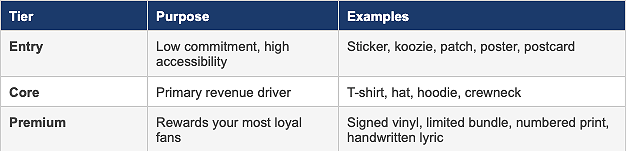
atVenu's data confirms what experienced merch operators already know: a small number of items drive the majority of sales, especially in country. Start narrow and strong. Expand when the data tells you to.
3. Tie Merch to Moments, Not Just Availability
The biggest passive mistake in artist merch: putting products in a store and waiting.
Fans buy when there is context, energy, and a reason to act now.
Every part of an artist's story is a potential merch moment:
A new single drops
A music video premieres
A tour date goes on sale
A fan milestone is hit
A Bandcamp Friday arrives
A seasonal or holiday window opens
Stop thinking: I have merch available.
Start thinking: I have a merch drop tied to this moment in the story.
A release-week shirt tied to one specific lyric. A signed poster available for seven days only. A bundle that pairs the digital single with a handwritten note. A limited pre-order item that disappears when the song drops.
Merch moves better when it feels alive. When fans sense a moment is real and passing, they act. When merch feels like it has always been there and always will be, it gets ignored.
4. Design Merch for the Fan, Not for Your Ego
This is where artists quitely lose the most traction.
Ask yourself the honest version of the question: Would my fan actually wear this in public, unprompted?
If the answer is hesitation, the design needs more work.
The merch that earns that answer is usually one of these things:
Insider: it means something to fans that outsiders might not immediately catch
Emotionally tied: it references a specific lyric, moment, or feeling from the music
Useful: it functions well in daily life, not just as a fan artifact
Limited: there is a real reason to buy it now instead of later
Better than expected: the quality surprises the fan in a good way
MIDiA's 2026 research consistently points to subtle, taste-driven merch outperforming obvious logo-forward pieces among younger, more engaged buyers. Not everything has to scream. Sometimes the smarter move is merch that lets the fan feel like they are in on something.
5. Match Your Sales Model to Your Stage
Not every artist should sell merch the same way. Career stage matters.
Early stage: Use print-on-demand carefully or run small test quantities. Focus on two or three brand-right products. Avoid over-ordering before you know what your fans actually want.
Growing: Build an owned online storefront. Pair it with live show sales. Create release-based drops. Start tracking who is buying and what they return for.
Building a real fan base: Add premium items, signed pieces, limited collections, and fan-exclusive bundles. Begin thinking about merch as a loyalty ecosystem, not just a product catalog.
Bandcamp works well for artists who want music and merch sold together in one artist-first environment. Artist-owned storefronts on Shopify make sense when the artist is ready to build a more branded commerce experience and own the customer relationship directly.
Choose the setup that fits your stage. Do not copy someone else's system before you have the audience to support it.
Five Habits to Drop Immediately
Stop making merch too late. If you are thinking about it the week of release, you have already limited yourself.
Stop guessing what fans want. Ask them. Run polls. Watch which lyrics and images get engagement. The data is there if you look.
Stop launching too many items too fast. More options create confusion, not more sales.
Stop making merch that could belong to anybody. Generic gets ignored. Branded gets remembered.
Stop treating merch like a side hustle. It is a core part of the artist business now. Treat it like one.
Your 30-Day Merch Action Plan
If you are serious about building a smarter merch strategy this month, here is where to start.
Define the artist's world in plain language. What does the music feel like? Who is the fan? What product belongs in that world?
Choose only three initial items. One entry-level product. One core wearable. One premium piece.
Tie everything to a specific moment. Not just "the store is open." Connect the launch to a release, show, or fan milestone with a real deadline.
Design for the fan's life, not your vision board. The question is not what you want to see. It is what your fan would actually buy, wear, and keep.
Make the purchase path simple. One clean link. Clear photos. Clear pricing. A real reason to buy now instead of later.
Track what moves. What sells first? What gets reposted? What gets ignored? That data should shape every drop after this one.
The Bottom Line
In 2026, merch is not the side table next to the tip jar.
It is one of the clearest ways to convert a curious listener into a committed supporter. It gives fans a physical attachment to the music. It creates direct revenue with real margins. It puts the artist's brand in the real world. And it builds a business model that does not depend entirely on whether a streaming algorithm decides to show up for you.
The artists who win with merch are not the ones who rush to print something because they feel behind.
They are the ones who build merch the same way they build songs: with clarity, intention, and a real understanding of what the fan wants to belong to.
Ready to Build a Smarter Plan?
If your merch still feels like an afterthought, it usually means the larger artist business needs a better system.
At Nashville Music Consultants, we work with independent artists, their families, and the people investing in their careers to build strategies that actually connect. That means aligning the brand, the release plan, the merch, and the fan growth so every part of the career reinforces the others.
We have seen what separates artists who build something lasting from artists who stay stuck. And we know how to close that gap.
Contact Nashville Music Consultants to start the conversation.
Sources
Bandcamp Artist Guide; Bandcamp for Labels; Bandcamp Fridays; atVenu Artist Merch Trends 2025; atVenu Top Selling Items by Genre; MIDiA Research, March 2026