Are You Using the Wrong Strategy for Your Stage as an Artist?
2026 marks my 40th year working in the music industry.
I've been so blessed to have worked with Reba McEntire at the peak of her career as Entertainer of the Year. I've helped artists secure record deals back when that was the only real path to success. I've managed the Roy Orbison catalog, proving that a legacy can outlive the artist. And I've sat across the table from hundreds of developing artists who had talent but no real plan.
Here's what those four decades taught me:
You're writing songs.
You're practicing.
You're posting.
You're doing the work.
But if you're honest, there's still one question hanging over everything:
"What am I supposed to do next?"
Music careers are not random. They move in stages. And when you try to use the wrong strategy for the stage you're in, you feel stuck, overwhelmed, and convinced everyone else is ahead.
The artists who make it are not always the most talented. They're the ones who understood what stage they were in and made the right moves for that moment.
So on that note, let’s first discuss…
The "Bell Curve" Nobody Explains
Most music careers follow a predictable pattern:
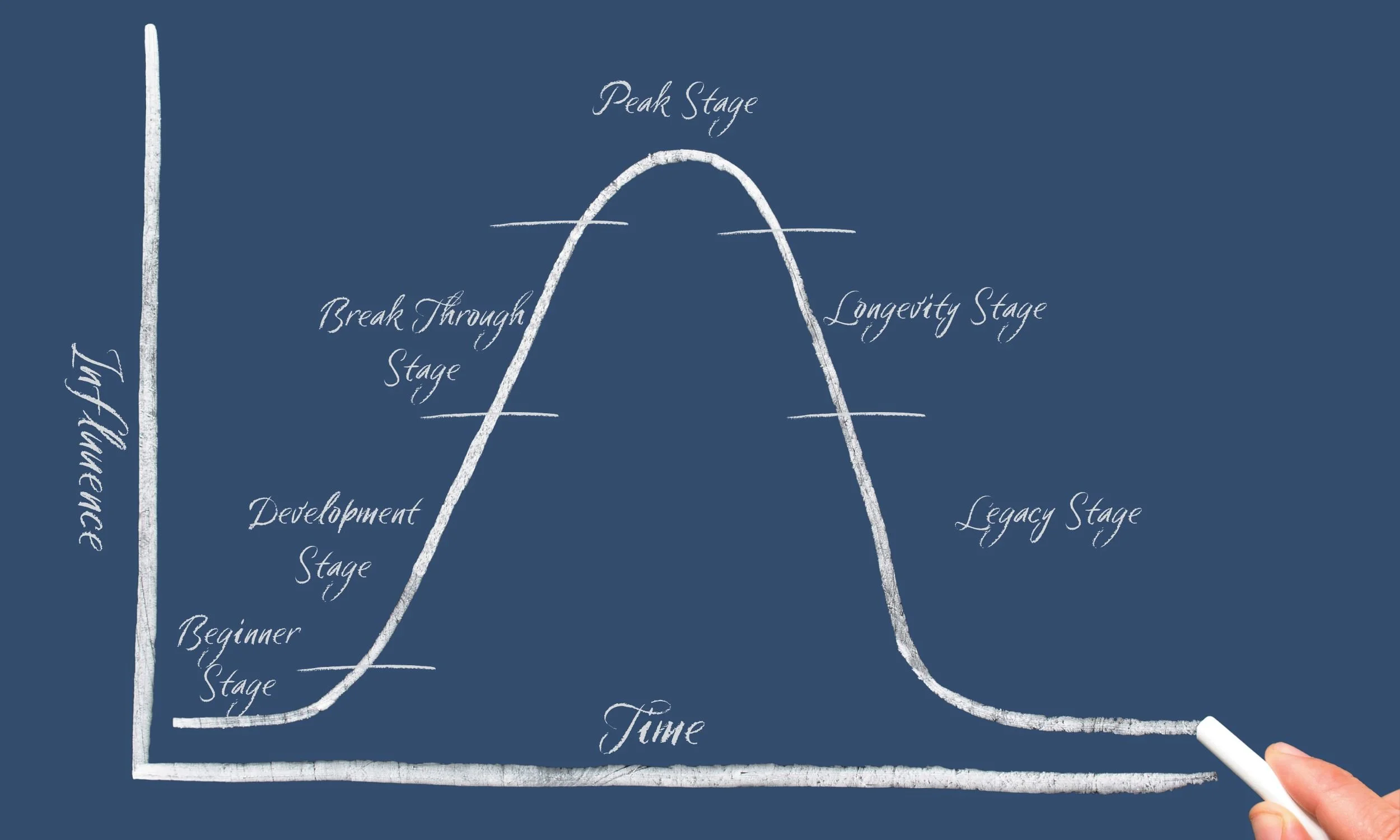
You build
You grow
You break through
You sustain
It looks like a bell curve: a rise, a peak, then a shift into longevity.
Not every artist reaches the same height, and that's okay. A "successful career" does not always mean stadiums. For many artists, success means consistent income, steady fans, real opportunities, and a life that supports making music long-term.
The problem is not your talent.
The problem is trying to reach a destination without a map. How do you get to where you want to go unless you know where you are?
So let's walk through the stages and what you should focus on in each one.
Stage 1: Beginner (Foundation)
This stage is not about fame. It's about formation.
Your job here is to build the core skills that everything else depends on.
What this stage looks like
Writing songs in your room
Posting covers or originals
Learning how to sing live with confidence
Playing small shows, or no shows yet
Experimenting with sound, style, and identity
The myth that ruins artists here
Myth: "If I was good, I'd already be blowing up."
Truth: This stage is about building, not visibility.
If you're here, your goal is not to "go viral." Your goal is to get better every month.
The reality? With over 100,000 tracks uploaded to streaming platforms daily, the competition is fierce. But that's not a reason to panic. It's a reason to focus on fundamentals while others chase shortcuts.
What to do right now
Pick consistency over perfection. Practice the fundamentals weekly: voice, performance, writing. Most breakthrough artists spent years in this stage before anyone noticed.
Learn the business basics early, not later. You don't need a business degree, but understanding how releases work, what royalties mean, and how to read a simple contract will save you thousands of dollars and countless headaches down the road.
Start documenting your journey. Simple content is enough. A phone video of you explaining what you learned in practice this week builds more connection than a perfectly produced post you agonized over for three days.
Set micro-goals you can measure. Not "get discovered" but "write one song per week for eight weeks" or "perform three open mics this month."
Most artists quit here, not because they lack talent, but because they think they are behind. You're not behind. You're in the foundation stage. And foundations take time.
Stage 2: Development (Momentum)
This is where things start to get real.
You begin getting feedback. People outside your circle start paying attention. And your habits matter more than your raw talent.
This stage is where careers are built or broken.
What this stage requires
You need three things:
1) A system
A repeatable rhythm for practice, content, writing, and releases. Not a perfect system. Just one you can actually maintain without burning out.
2) A strategy
A clear reason behind what you're doing, so you stop throwing spaghetti at the wall. Why this song? Why this platform? Why now? If you can't answer those questions, you're guessing.
3) A 6 to 12 month target
Not a dream. A real plan you can execute. Research shows that effective artist development programs focus on specific, achievable skill gaps over 6 to 12 months rather than vague, long-term aspirations.
Here's the trap
Most developing artists copy what big artists do.
They copy the content style. They copy the visuals. They copy the rollout. They copy the vibe.
But they are copying someone in a completely different stage.
That's like a high school player copying an NFL training camp and wondering why they burn out.
A major artist with 500,000 followers can post a cryptic photo with no caption and get engagement. You cannot. You need context, connection, and consistency because you're still building trust.
A signed artist can drop a single with two weeks' notice. You need two months of runway to build anticipation because you don't have a label's marketing machine.
What to do right now
Build a weekly schedule you can actually keep. Not an ideal schedule. A realistic one. Three hours of focused work beats seven hours of distracted chaos.
Choose a simple content lane. Not ten lanes. One or two. If you try to be on every platform doing every trend, you'll do all of it poorly. Pick where your audience actually is and show up there consistently.
Release with intention, not panic. Every release should have a purpose. Is this song introducing your sound? Building your email list? Testing a new style? Know the answer before you hit publish.
Track progress with real metrics. Growth, engagement, email list size, show reps, song quality. Write these down monthly. Progress is not always loud, but it should be measurable.
Stage 2 is where "hope" must turn into "structure." The artists who make it out of this stage are the ones who treat their music like a small business, not just a passion project.
Why The Timeline Changed (And What It Means For You)
This part matters, especially if you're comparing yourself to artists from 10 or 20 years ago.
Today, careers usually take longer to build, but they cost less to start.
You don't need permission from a label to release music. But you do need clarity, consistency, and patience.
In 2026, your brand identity matters as much as your music. Fans expect consistency across your social media, artwork, live shows, and merchandise. They want to know who you are, not just what you sound like.
This is actually good news. It means you can build a sustainable career on your own terms. But it also means the old playbook doesn't work anymore.
What this means for you
Slow growth is normal. If you're gaining 50 real, engaged followers per month, you're doing better than most. Stop comparing your month two to someone else's year five.
Skill stacking beats chasing virality. The artist who can write, produce, perform, and market will always outlast the artist who went viral once and doesn't know what to do next.
Long-term artists win, not one-hit moments. Sustainability matters more than a spike. Build something that can last five years, not five weeks.
If you're a parent supporting a young artist, this is important: Progress is not always loud. Sometimes it looks boring before it looks impressive. Trust the process.
Stage 3: Breakthrough and Peak (Pressure)
This stage is real, and it's exciting.
More opportunities. More eyes. More pressure. More consequences.
But here's the truth: Breakthrough is rarely an accident. It's usually the result of years of Stage 1 and Stage 2 done correctly.
You can't skip here, but you can prepare for it.
And preparation looks like this:
Strong songs that represent your best work
Consistent performance ability (you can deliver every time, not just when you're "feeling it")
A clear brand and message (people know what you stand for)
Real fan connection (an email list, a community, people who care)
A system you can scale (when opportunity comes, you can handle it)
When breakthrough happens, it moves fast. The artists who thrive are the ones who built infrastructure before they needed it.
Stage 4: Legacy and Longevity (The Long Game)
Legacy is not just fame.
Legacy is stability. Sustainability. Respect. The ability to keep creating without chaos.
The artists who last did not wait until success to get organized. They planned early. They built systems early. They protected their momentum early.
That's why the early stages matter so much. What you build in Stage 1 and Stage 2 determines whether Stage 3 becomes a launching pad or a crash landing.
Why I Focus on the Early Stages
At Nashville Music Consultants, I spend most of my time helping artists in Stage 1 and Stage 2 for one reason:
This is where confusion turns into burnout. And this is where clarity changes everything.
When an artist understands what stage they are in, what the real goal of that stage is, and what to stop doing and what to start doing, everything shifts.
They stop guessing. They stop copying. They stop wasting money on strategies that don't fit their current reality.
And they start progressing.
What we help artists do
Identify where you are in the career life cycle
Build a strategy that actually fits your stage
Create a simple operating system you can execute weekly
Turn "I hope this works" into "I know what I'm doing next"
We don't promise overnight success. We promise a clear path forward.
The Takeaway
If you remember one thing, make it this:
You're not late. You're not behind. You're just in a stage. And each stage requires different moves.
Stop measuring your Stage 1 against someone else's Stage 3. Stop copying artists who have teams, budgets, and infrastructure you don't have yet. Stop panicking because you're not where you think you should be.
Instead, do this today:
Identify your current stage (be honest)
Stop copying artists in a different phase
Build systems for where you are right now
When you understand the cycle, you stop panicking. And you start planning.
Want Help Mapping Your Stage?
I hope these weekly blogs hit home for you. My goal is to provide you clarity, confidence, and a plan you can actually execute.
And if you want a real plan for your specific situation, you can book a free 30-minute consultation with me at Nashville Music Consultants.
You don't need more random advice. You need the right strategy for the stage you're in.